The Quiet Geometry of a Lane Bend
Read a lane bend through its edges, curves, and sightlines to understand how it shapes direction and distance without assuming every route works alike.
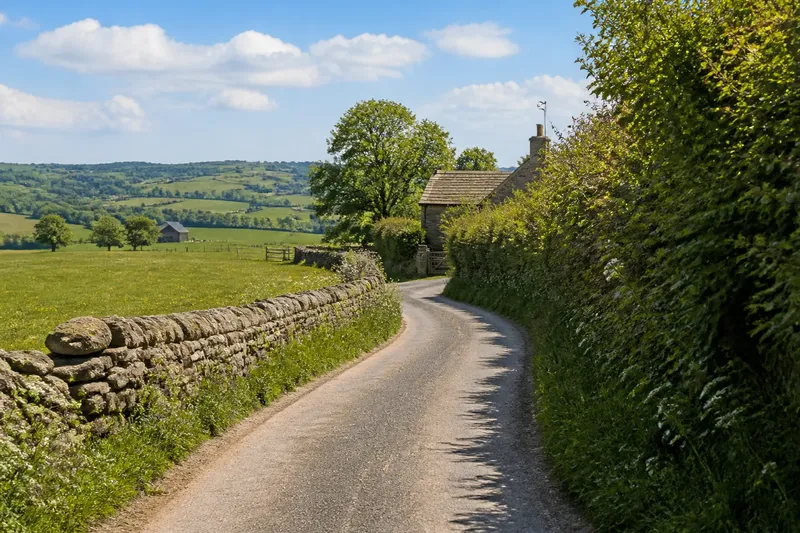
At a bend in a narrow lane, a gate may vanish before the road does. The view ahead narrows, a hedge takes over the inside edge, and the far stretch seems closer—or farther—than it looked from the straight. Reading the quiet geometry of a lane bend means noticing how these visible cues shape your sense of direction and distance, without assuming that every curve tells the same story.
Take the lane at an unhurried walking pace and begin with what you can actually see. You do not need a map, measuring tools, or a theory about why the road was laid out this way. A few deliberate pauses can reveal how the route presents itself to a walker, one section at a time.
Start where the lane begins to turn
Choose a bend where you can stand safely off the traveled part of the lane, with a clear view of the approach. Keep to a verge or other suitable margin, and stay alert to vehicles, bicycles, and uneven ground. A quiet lane can still be in use; do not step into a blind section to get a better angle.
Before moving, look back along the stretch you have just walked. Notice where the curve first became apparent. Was there an early hint, such as a hedge that began to arc, or did the lane seem straight until a wall, tree, or bank blocked the view? This starting point matters because a bend can announce itself through the edges before the road surface visibly turns.
Now look forward without trying to see around the curve. Pick out the nearest point where the lane disappears from view. It may be hidden by a hedgerow, a stone wall, a house, a rise in the ground, or simply the angle of the road. That point is a visual limit, not necessarily the bend’s tightest point or its end.
Let the edges reveal the shape
Follow both sides of the lane with your eyes. The inside edge is the side toward which the road curves; the outside edge arcs around the other side. A verge may make one edge easy to trace, while a wall or hedge makes the other feel unusually firm. Look for changes in spacing and alignment rather than trying to assign the curve a precise radius.
Edges can disagree. A ditch might continue smoothly while the road surface appears to kink beside it. A hedge may bulge outward, making the lane seem tighter than it is, or a low wall may expose the curve more clearly than a tall bank on the opposite side. Those differences are part of the view. They remind you that a lane is not just a line on the ground: it is a passage framed by whatever borders it.
Notice openings and interruptions, too. A farm entrance, footpath, bridge parapet, or gap in a hedge can offer a brief cross-view into fields or gardens. Such an opening may make the bend feel more open even if the forward sightline remains short. A solid run of hedge can have the opposite effect, making a gentle arc feel enclosed.
Compare what the curve hides and reveals
Walk a little farther along the safe margin, pausing as the view changes. Watch which feature appears first: a roof, a tree crown, a gatepost, a road sign, or the continuation of the lane itself. Then note what remains hidden. These small appearances give the bend a sequence. You may see a chimney before the house, or a bright patch of sky before the road beyond it.
A bend’s sightline is the part of the route visible from where you stand. It can be short because the curve turns away, because the land rises, or because a boundary is tall and close. A low hedge over level ground may allow a long view across a field while concealing the road around the turn. Separate the view along the lane from the view across it; they answer different questions.
Imagine you approach a bend with a tall hedge on the inside and a low stone wall on the outside. From the approach, the hedge hides the continuation, while the wall lets you see a field and a distant barn. As you walk on, the barn slips behind the hedge and a gate farther down the lane comes into view. The observable change is not that the road has shortened or lengthened, but that the visible landmarks have shifted as your position changed.
Ask what makes distance feel different
Distance along a lane is not always easy to judge by eye. A curve breaks the view into sections, and the hidden stretch has no visible endpoint to compare with the ground near your feet. A nearby tree can dominate the scene, while a distant building may look small enough to seem farther away than it is.
Use stable features as reference points, but treat them as visual aids rather than measuring devices. A gate, bridge, or distinctive tree can help you remember where one stretch gives way to another. As you move, notice whether the feature grows gradually, appears suddenly, or stays hidden until you pass a particular boundary. That sequence is often more informative than a quick guess at the distance.
The analogy is a book partly closed at the spine: you can see the page in front of you, but the fold conceals what follows. A lane bend works differently from a page in many respects, yet the comparison helps explain why a hidden continuation can feel farther away than an equally long, straight stretch. The road’s visible section is not the whole route.
Read the bend without assigning it a single purpose
It is tempting to look at a curve and decide immediately that it was designed for a particular reason. The visible shape alone rarely settles that question. A lane may follow a field boundary, pass between buildings, skirt a slope, meet a bridge, or reflect several changes made over time. From the roadside, you can describe what the bend does to the view without claiming to know why it exists.
Instead, separate observation from inference. “The hedge hides the next section until the gate” is something you can check as you walk. “The lane curves to protect a house from the wind” is a proposed explanation that needs evidence beyond the shape of the road. Keeping those statements apart makes your reading more precise and leaves room for other plausible accounts.
Different lanes can produce similar visual effects through different arrangements. A broad sweep beside a low fence may offer a long, open view. A tighter turn framed by buildings may conceal the road almost immediately. Neither arrangement is a universal model for a good or bad bend; each gives the walker different information at a different point.
How should you describe a lane bend?
What is the inside edge of a bend?
It is the edge toward which the road turns, as opposed to the outside edge that arcs around the other side. In a real lane, hedges, walls, verges, and ditches may make the two edges look quite different.
Why can a gentle curve feel like a sharp turn?
A close hedge, a high wall, or a rise can hide the continuation and make the visible road seem to stop abruptly. The curve’s appearance depends on its surroundings as well as the direction of the road surface.
How can you tell whether a bend hides a long stretch?
You cannot reliably judge the hidden distance from a single viewpoint. Note where the lane disappears, then observe how landmarks emerge as you continue along a safe route.
Can a bend reveal direction even when the road is hidden?
Often, the edges suggest which way the lane is turning even before the continuation becomes visible. A hedge’s arc, the alignment of a wall, or a line of trees may make the direction legible without revealing what lies beyond.
Walk through the view in sequence
After observing from the approach, continue only where the route is safe and open to you. Do not cross private boundaries or enter a closed lane. Pause again once the bend begins to open, and compare the scene with your first view. Which edge has moved out of the way? Has the hidden section appeared all at once or gradually? Does the opening reveal the same landmarks you expected?
Then glance back from the far side. The bend may now frame the stretch you came along, which can make its direction easier to recognize. A building that was obscured on the approach might sit plainly in view behind you. This reversal is useful: it shows that a sightline belongs to a particular position, not to the lane as a whole.
You can keep a short record in a notebook if you want to compare bends on a walk. Write down the approach, the edge that first signals the turn, the object that disappears, and the feature that appears beyond it. Sketching two or three simple lines is enough; there is no need to make a scale drawing. The aim is to preserve the order of what came into view, not to claim a survey of the route.
Keep the account close to what you saw
A useful description gives another walker a sense of how the lane unfolds. You might say that the road curves left behind a high hedge, that a low wall opens a view across fields, and that a gate appears only after the turn begins to ease. Those details convey direction and enclosure more clearly than a bare label such as “sharp bend.”
Include uncertainty where the view leaves something unknown. You can say that the road disappears behind a bank and that its continuation becomes visible farther on. You do not have to decide how long the hidden stretch is, who first laid out the lane, or what the bend was meant to accomplish.
When you read the quiet geometry of a lane bend, the most useful question is simple: what changes as I move? Track the edges, the disappearing points, and the landmarks that return to view. That close attention makes a familiar route easier to describe, while leaving each lane room to be its own particular shape.