The Map Name That Sounds More Certain Than It Is
Learn how to read a place name’s present meaning separately from uncertain origins, using a weeklong routine to weigh maps, signs, and local clues.
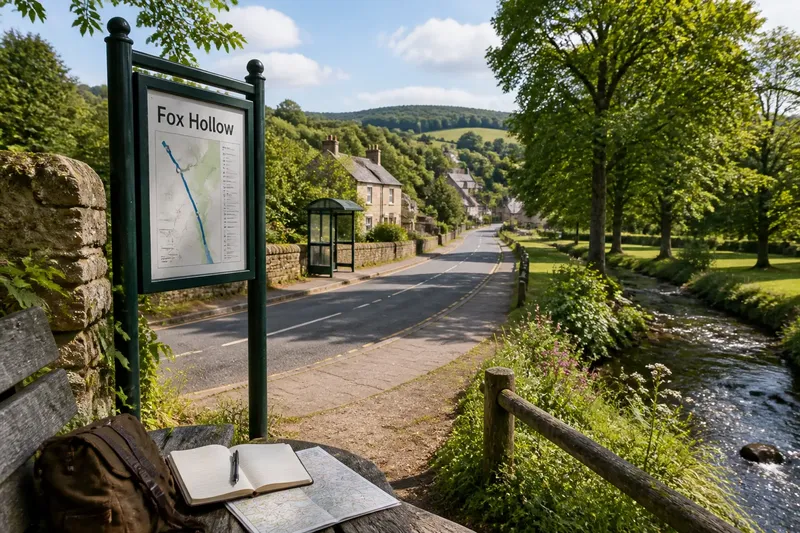
At a bus stop, Fox Hollow appears on the route map in neat, confident letters. The place name may suggest foxes and a hollow, but its present-day use is easier to confirm than its origin. A week of focused checks can help you describe both without turning a plausible guess into a settled story.
Record what the place name identifies today
Copy the exact spelling and punctuation from a current street sign, transit map, park notice, or local map. Note where you saw it and what feature the label appears to identify. If a sign says “Old Mill Road” while a map prints “Old Mill Rd.,” preserve both forms rather than silently choosing one.
Then ask how people use the name in ordinary directions. Do they mean a whole neighborhood, a road, a bend, or only the green beside the library? Present-day usage helps establish what the name refers to now; it does not, by itself, explain how the name began.
Keep two questions distinct: “What does this name refer to here?” and “How did it originate?” The first may be clarified by looking around or asking for directions. The second can remain uncertain even after an old record turns up.
Use a week of checks to build a careful account
Give each day a defined task. For every clue, record its source and what it can actually support. If a check produces no useful answer, note that plainly and move to another kind of evidence.
- Day one: Check the name on a current sign or official map. If the spelling and labeled feature are clear, record them as the current form; if sources differ, preserve each version and identify its source.
- Day two: Look for the feature suggested by the name, such as a mill, ford, orchard, or meeting place. If it is visible, note its location without treating it as proof of origin; if it is absent, leave open the possibility that the landscape changed or the name has another source.
- Day three: Compare another current source, such as a transit map or park sign. If it matches, record the agreement; if it differs, keep both spellings and check whether they label the same place.
- Day four: Ask a local librarian, historical society, or long-time resident about the name’s use and any remembered story. If someone offers an account, attribute it as a local memory; if no one knows one, record that rather than inventing an explanation.
- Day five: Consult a local history book, gazetteer, or archival map if available. If it gives an older form or a direct explanation, copy the wording and source; if it only labels the place, treat it as evidence of usage, not of why the name was chosen.
- Day six: List possible readings beside the clues that support each one. If a clue directly connects a name to an event or feature, describe that support; if the connection rests on resemblance alone, mark it as a possibility.
- Day seven: Draft a short account separating current use, documented forms, and remembered explanations. If the evidence supports an origin, state what supports it; if it does not, say the origin remains unclear.
Keep the notes in separate columns, much as a recipe card distinguishes ingredients from the cook’s optional substitutions. One column can hold visible observations, another source wording, and a third remembered accounts. That format makes the source of each claim easy to see.
Do not let a familiar meaning decide the origin
A place name can resemble an ordinary English phrase without preserving its earliest meaning. Words shift, spellings change, and familiar sounds invite later interpretations. “Mill” in a name may point toward a useful question, but the word alone does not establish that a mill stood there.
A visible feature can create the same temptation. If mature willows line Willow Street, the trees explain what a visitor notices now; they do not prove that the trees gave the street its name. The name could have come first, or the association could have developed later.
Say you find “Fox Hollow” on a town map, see no hollow nearby, and hear a neighbor say the name came from foxes near an old field. You record the map’s label, the landscape you can see, and the neighbor’s account in separate notes. An archival map later shows the same spelling but offers no explanation. Your resulting account can say that Fox Hollow is the name in use and that a fox-related origin is remembered locally, while making clear that the map does not settle the origin.
Read historical wording and maps for what they say
Pay close attention to a local source’s verbs. “Was named for” asserts a direct connection; “may refer to” signals uncertainty. Check whether the source points to an older spelling or document, or simply repeats a familiar story. A confident sentence is not the same thing as a documented naming event.
An old map can trace how a name was written and which feature it labeled when the map was made. It does not automatically reveal who coined the name or why. Unless the map explains the naming, its silence should remain part of your account.
Records may also differ because they were created for different purposes. A property document might use a name for one parcel, while a later map applies it to the surrounding area. Note each source’s date and context as presented, and avoid treating an older-looking form as definitive merely because it appears first in your notes.
Which place name clues can support an origin story?
Does a name’s literal meaning prove where it came from?
No. A familiar meaning can suggest a possibility, but it cannot establish the naming event by itself. Look for an older form or a source that directly connects the word to the place.
Can a local story count as evidence?
Yes, as evidence that an explanation is remembered or told locally. Unless independent records support the origin, describe it as a local account rather than a settled explanation.
What does an old map tell you?
It can show that a name or spelling was in use when the map was made and indicate which feature it labeled. Without an explanation, it cannot tell you why the name was chosen.
What should you write when the origin remains unclear?
Say so plainly, then give the present-day meaning and the best-supported possibilities. That wording shows readers where the evidence ends and interpretation begins.
Choose wording that fits the evidence
For a short caption, you might write: “Fox Hollow is the name used for this stretch of the park; a local account links it to foxes, though the origin is uncertain.” This identifies the place, preserves the remembered story, and does not present an unverified explanation as fact.
If a source explicitly says a road was named for a nearby orchard, you can state that connection and identify the source. If one record says “Orchard Lane” while another gives a different explanation, name the disagreement instead of smoothing it away.
A careful account of a place name gives readers both a usable present-day reference and an honest sense of what its past can support. When you search for a place name’s origin, keep the map label, visible landscape, and local memory distinct; that small habit leaves room for a better-supported explanation to emerge later.