A Notebook for Noticing One Street
A notebook for noticing one street helps you map visible details, separate observations from guesses, and compare how the same block appears on return visits.
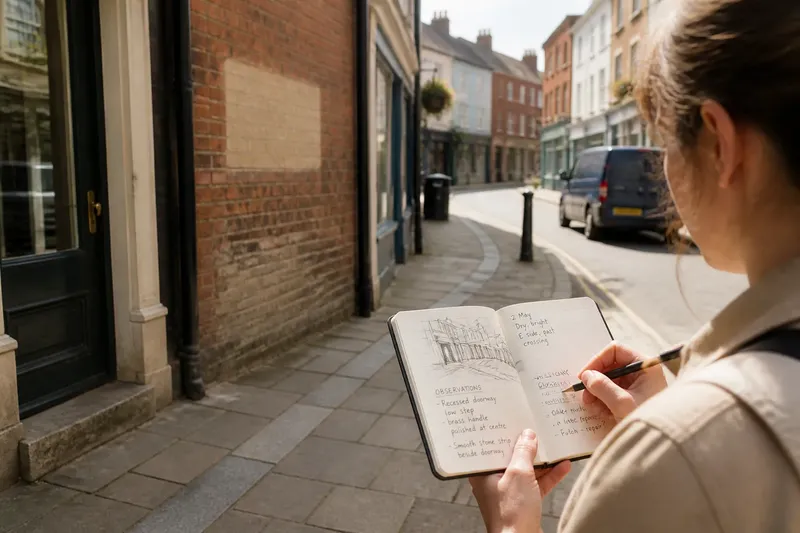
You stop beside a brick wall and notice a pale rectangle where a sign may once have hung. A notebook for noticing one street can help you describe that mark without deciding its history on the spot. Write down what you see, where it sits, and what conditions might be hiding other details.
Choose a public route you can walk comfortably, and bring a pocket notebook and pencil. The point is to pay attention to the street itself, not to identify the people who live or work there. A few clear notes are more useful than a page of guesses.
Choose a route you can describe
Pick a short stretch with visible changes: a row of storefronts, a residential block, or a road where paving shifts near a corner. Start at a recognizable public place, such as a bus stop or crossing. Write the direction you plan to walk and note conditions that affect what you can see, including rain, parked vehicles, or closed shutters.
Give each entry a simple location cue: “east side, just past the crossing” or “beside the green gate.” A quick sketch can show the order of features, but it does not need to work as a map for anyone else.
Describe what is there before deciding what it means
When a detail catches your eye, record its visible qualities first. Instead of “welcoming entrance,” write “recessed doorway, low step, brass handle polished at the center.” Instead of “busy pavement,” note “smooth paving beside the shopfront; rougher blocks near the curb.” Those descriptions leave room for more than one explanation.
Useful details can be ordinary: a repaired seam, a change in wall material, a gate set back from the pavement, or a worn edge on a step. Think of observation and interpretation as separate bowls on a kitchen counter. Keeping them apart makes it easier to see which ingredients you actually have.
Use three headings: structure, surface, and change over time. Under structure, note openings, walls, steps, and boundaries. Under surface, record materials and repairs. Under change over time, add features that might vary between visits, such as an open shop door or a delivery vehicle obscuring a wall.
Keep possible explanations in their place
A worn threshold might suggest repeated use, weather, or an old repair. None of those explanations follows automatically from the mark. Write the observation in plain language, then put possible explanations under a separate “questions” heading with a question mark.
Say you see a narrow strip of smooth stone beside rough paving. First, note its location and how far it continues. Then record a question: “Could this mark an older route, or is it part of a later repair?” On a return visit, you notice it continues past a doorway and disappears at a newer patch. The result is a more precise description of where the strip runs, not proof of its history.
Check for details beyond the first thing you noticed
One kind of feature can take over your attention. If you have filled the page with doorways, look down at the paving; if you have been tracing repairs, look up at the roofline and wall openings. Use these checks to widen your attention, not to complete a formal survey.
- Thresholds: If a step, gate, ramp, or recess is visible, record its position and form; if its purpose is unclear, describe it without assigning a use.
- Surface changes: If one material meets another, mark where the change begins and ends; if you cannot see the boundary clearly, note what blocks the view and revisit it only if convenient.
- Repairs: If a patch or seam stands out, describe its shape, material, and location; if you cannot distinguish repair from original construction, leave that question open.
- Openings: If a doorway or window differs from its neighbors, note the visible difference; if the building is occupied, do not infer who uses the opening or why.
- Surrounding features: If a wall, drain, sign, or fence helps you relocate a detail, include that landmark; if it could identify a resident or private space, use a less specific cue.
- Changing conditions: If weather, parked vehicles, or a closed shutter affects visibility, record the condition; if it hides an important feature, note that the view is incomplete rather than filling in the gap.
Stay on public routes and keep attention on the place’s visible features. Do not record private conversations or turn someone’s belongings or routine into a clue. If anyone seems uncomfortable, put the notebook away and move on.
Compare visits without turning change into a claim
Keep each visit on its own page. Add the date, direction, and conditions, then note what looks consistent and what appears different. An open doorway on one day and a closed one on another describe two moments; they do not establish a regular pattern.
Imagine Maya walks a public block on a dry afternoon and writes, “smooth stone strip beside the bakery doorway; continues toward the corner.” She also notes a parked van partly blocks the wall. On a later visit, she finds the van gone and sees the strip stop at a rectangular patch of newer-looking paving. She adds that observation to a fresh page and keeps two questions open: whether the strip belongs to an earlier surface, and whether the patch is a repair. Her notes now distinguish the visible route of the stone from the uncertain story behind it.
What should you do when you cannot name a feature?
How do you describe an unfamiliar building detail?
Use shape, material, position, and nearby landmarks rather than guessing a technical name. “Raised stone strip beside the doorway” gives a reader something visible to look for, while a possible term can remain a question.
How can you separate an observation from an interpretation?
Put descriptions under an observations heading and possibilities under questions. “Paint is chipped along the lower edge” is an observation; repeated contact or weather are possible explanations, not settled facts.
Should you return to the same street?
A return visit can show which details are obscured or changing under different conditions. Keep the new notes separate, and treat each visit as a record of what was visible at that time.
How can you take notes without intruding?
Stay in public places, focus on buildings and street features, and leave residents unidentified. If your attention makes someone uncomfortable, close the notebook and continue elsewhere.
Share descriptions that leave room for uncertainty
After the walk, underline details you could point out again without relying on a guess. If you share a note, remove identifying details and keep uncertainty clear. “A smooth strip meets rough paving beside a recessed entrance” invites another person to see the feature; a claim about what the strip once meant may go beyond what the street has shown.
For a notebook for noticing one street, the most useful ending is often a precise open question. Write down what you would look for next time, such as whether a wall seam continues around a corner. That gives a future walk a focus without asking an ordinary street detail to tell more than it can.